Guess what? Comet Holmes is still freaking in the sky! Who knew. It's fading, but apparently visible in the northern skies. On March 4th, it was in the same area as the red emission nebula the California Nebula. The cool thing I found about this picture is that the two objects appear to be about the sameish size, but Comet Holmes is only 25 light minutes away and 20 light seconds in diameter, whereas the California Nebula is about 100 light years long and 1500 light years away. The bright star is Xi Persei. The color of the California Nebula comes from hydrogen atoms recombining with "long lost" electrons that were originally ionized by UV star light.
Friday, March 7, 2008
3.9 APOD Comet over California
Guess what? Comet Holmes is still freaking in the sky! Who knew. It's fading, but apparently visible in the northern skies. On March 4th, it was in the same area as the red emission nebula the California Nebula. The cool thing I found about this picture is that the two objects appear to be about the sameish size, but Comet Holmes is only 25 light minutes away and 20 light seconds in diameter, whereas the California Nebula is about 100 light years long and 1500 light years away. The bright star is Xi Persei. The color of the California Nebula comes from hydrogen atoms recombining with "long lost" electrons that were originally ionized by UV star light.
Thursday, March 6, 2008
Simon Newcomb Bio
Simon Newcomb was born in Wallace, Nova Scotia, Canada on March 12, 1835 to Emily Prince and John Newcomb. Though born in Canada, his parents were of New England descent and his father was a traveling school teacher. As such, Simon received little conventional education but learned much from his father. When Simon was sixteen, he became apprenticed to a quack doctor, Dr. Foshay, and after two years of that became aggravated and walked one hundred and twenty miles from Canada to Maine in order to join his father in New England.
Newcomb became a traveling school teacher like his father, and moved near Washington D.C., where he visited the Smithsonian Institution’s library with regularity. He decided to teach himself mathematics primarily through reading Newton’s Principia. Newcomb moved to the Cambridge in 1857, where he was employed as an astronomical computer at the Nautical Almanac Office.
The American Civil War in 1861 caused many teachers with Confederate sympathies to resign from the United States Navy, and as such Newcomb as invited to fill a vacancy at the Naval Observatory. He then began to essentially force the astronomers at the Naval Observatory organize the way they did right ascension and declination measurements of stars. Whereas before the astronomers tended to pick out random stars for random observations, Newcomb made them follow certain stars and keep meticulous observations throughout both the night and the day. While working for the Naval Observatory, Newcomb disproved the prevalent theory that the minor planets were fragments of a larger planet that had exploded or been shattered due to a collision.
Worried about Hansen’s table, in 1871 Newcomb traveled to Paris to obtain a longer list of observations about the position of the moon from the Paris observatory. He succeeded in obtaining observations from as far back as 1672 and left the city before serious rioting occurred. Newcomb used the observational information to deal with the problem of “fluctuation” between where the moon should be and where it was for the rest of his life and later led to investigations on the variations in the rate of rotation of the Earth.
Newcomb developed new tables and theories of motion of the Sun, the moon, and planets through the main use of Encke’s method, but used Hansen’s for Jupiter and Saturn with his apprentice, G.W. Hill. “Newcomb operators” are used to figure out perturbative action of one planet with an elliptical orbit on another. His measurement of the speed of light was used for a long time as the astronomical standard and he computed the mass of Jupiter from observations of Polhymnia, a calculation that has never been greatly improved on. He also reformed the theoretical and computational basis of American Ephemeris.
Newcomb once claimed that man would never be able to fly due to always having to come back down to the ground (gravity), but this was truly the only great failing of his uncanny foresight. He wrote several books on Astronomy and Mathematics, perhaps most importantly Astronomy for Everybody, which was published in 1902. He did write one science fiction novel, His Wisdom the Defender.
Newcomb died in Washington D.C. on July 11, 1909. President Taft attended his funeral in honor of the greatest American astronomer of his time.
Works Cited:
"Simon Newcomb." Wikipedia. 03 Mar. 2008 .
"Simon Newcomb." Dictionary of Scientific Biography. 9th vol. New York: Charles Scribner's Sons, 1981.
Newcomb became a traveling school teacher like his father, and moved near Washington D.C., where he visited the Smithsonian Institution’s library with regularity. He decided to teach himself mathematics primarily through reading Newton’s Principia. Newcomb moved to the Cambridge in 1857, where he was employed as an astronomical computer at the Nautical Almanac Office.
The American Civil War in 1861 caused many teachers with Confederate sympathies to resign from the United States Navy, and as such Newcomb as invited to fill a vacancy at the Naval Observatory. He then began to essentially force the astronomers at the Naval Observatory organize the way they did right ascension and declination measurements of stars. Whereas before the astronomers tended to pick out random stars for random observations, Newcomb made them follow certain stars and keep meticulous observations throughout both the night and the day. While working for the Naval Observatory, Newcomb disproved the prevalent theory that the minor planets were fragments of a larger planet that had exploded or been shattered due to a collision.
Worried about Hansen’s table, in 1871 Newcomb traveled to Paris to obtain a longer list of observations about the position of the moon from the Paris observatory. He succeeded in obtaining observations from as far back as 1672 and left the city before serious rioting occurred. Newcomb used the observational information to deal with the problem of “fluctuation” between where the moon should be and where it was for the rest of his life and later led to investigations on the variations in the rate of rotation of the Earth.
Newcomb developed new tables and theories of motion of the Sun, the moon, and planets through the main use of Encke’s method, but used Hansen’s for Jupiter and Saturn with his apprentice, G.W. Hill. “Newcomb operators” are used to figure out perturbative action of one planet with an elliptical orbit on another. His measurement of the speed of light was used for a long time as the astronomical standard and he computed the mass of Jupiter from observations of Polhymnia, a calculation that has never been greatly improved on. He also reformed the theoretical and computational basis of American Ephemeris.
Newcomb once claimed that man would never be able to fly due to always having to come back down to the ground (gravity), but this was truly the only great failing of his uncanny foresight. He wrote several books on Astronomy and Mathematics, perhaps most importantly Astronomy for Everybody, which was published in 1902. He did write one science fiction novel, His Wisdom the Defender.
Newcomb died in Washington D.C. on July 11, 1909. President Taft attended his funeral in honor of the greatest American astronomer of his time.
Works Cited:
"Simon Newcomb." Wikipedia. 03 Mar. 2008 .
"Simon Newcomb." Dictionary of Scientific Biography. 9th vol. New York: Charles Scribner's Sons, 1981.
Friday, February 29, 2008
3.8 APOD
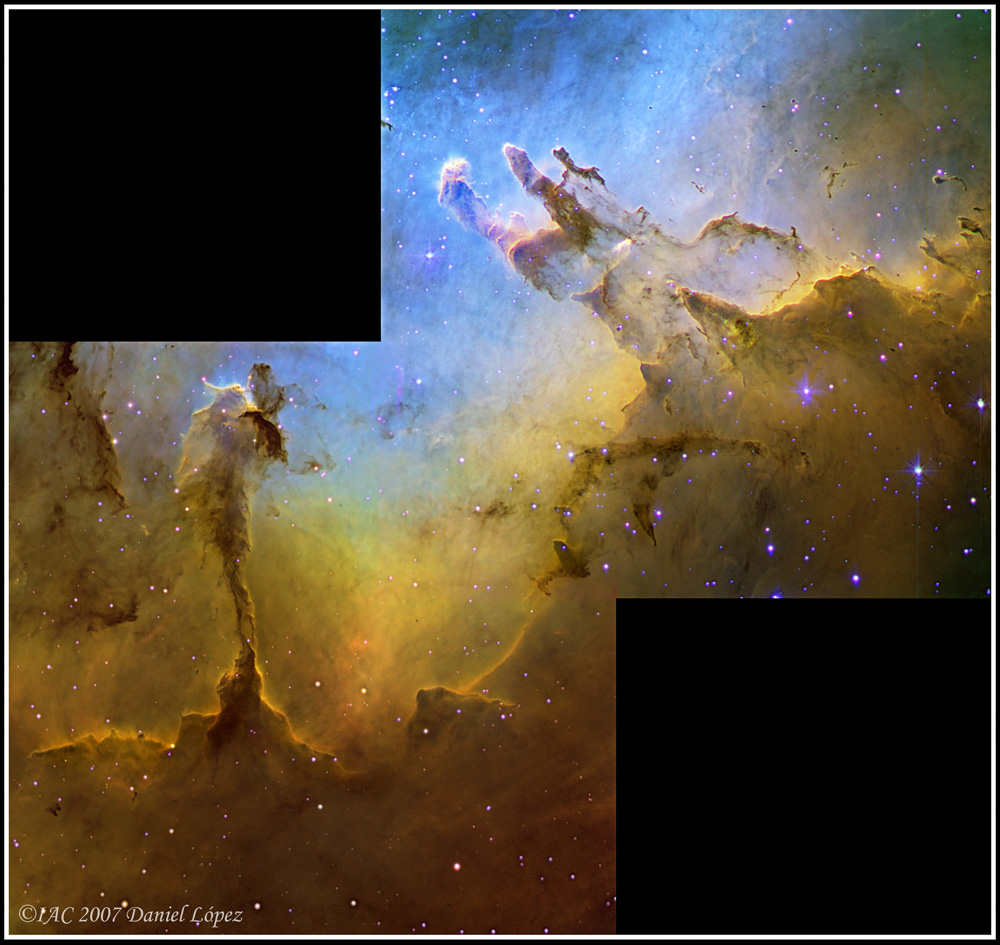
Look, it's our favorite 1995 Hubble Telescope picture of the Eagle Nebula (M16, Serpens) that we studied in class! :D I actually really like this picture, and enjoy the idea of the EGGs in the columns and that's why I chose this picture. And it's just gorgeous. Things like this make people actually interested in Astronomy because they're just amazingly beautiful and almost spiritual.
This is obviously a fake color photo taken of the Pillar of Creation and Fairy, the two features named in the Eagle Nebula.
3.7 APOD
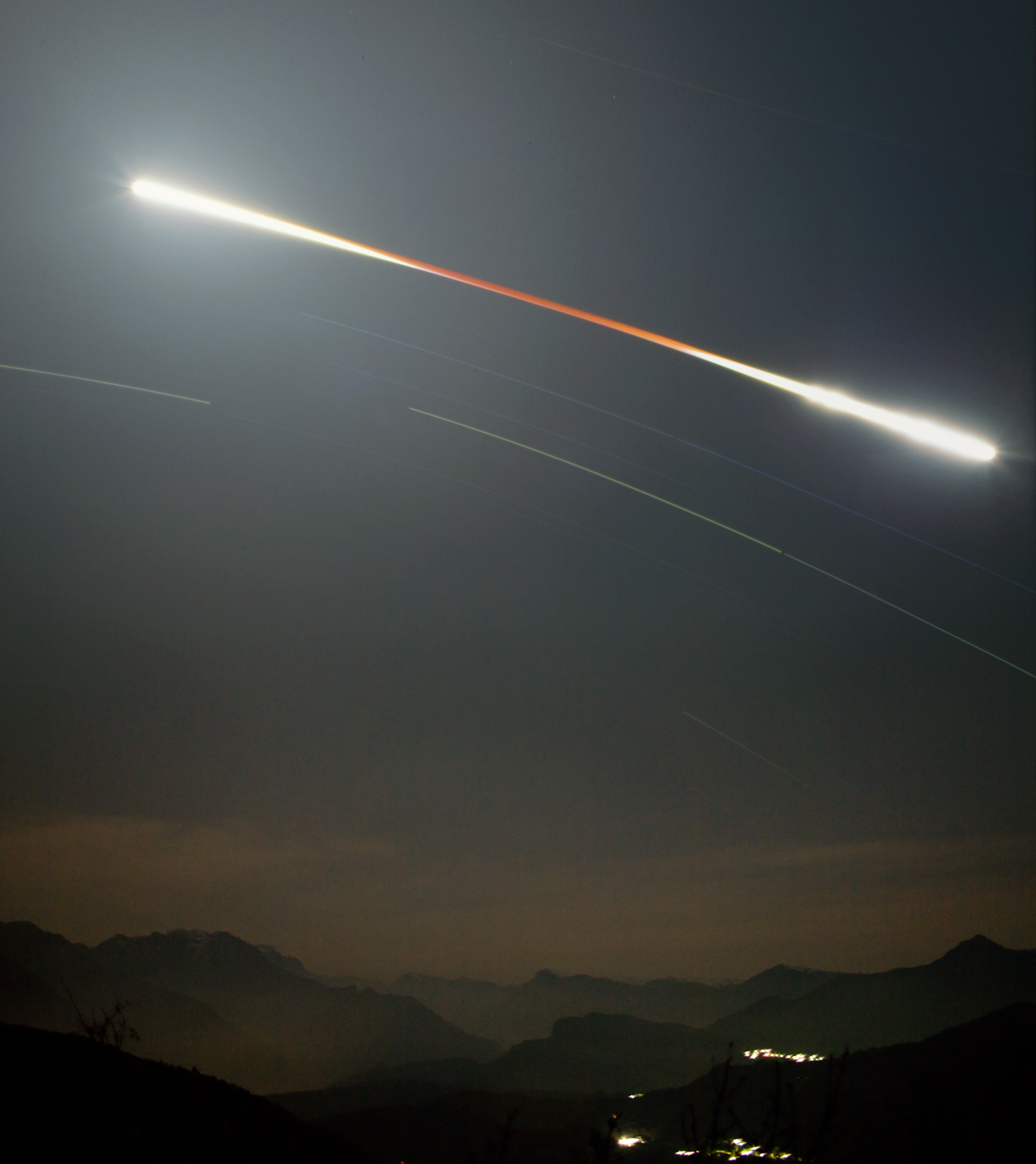
This is a long exposure photo of the March 3rd 2007 lunar eclipse. The photographer left his camera shutter open while on a tripod. The large line that gets slimmer and red in the middle is the moon. The reddish hue is common to lunar eclipses. The other trails are just star trails. APOD put this up in honor of the Lunar Eclipse that we didn't get to see due to clouds. Stupid clouds. The rest of the articles just comment on how lunar eclipses are watched by completely casual sky gazers, and well everyone, and that the next lunar eclipse won't be until December 2010. Suckfest.
Thursday, February 28, 2008
Star Formation Links
1. http://www.sciencedaily.com/videos/2007/0607-first_stars_in_the_universe.htm News article/video about discovering the first stars in our universe.
2. http://www.sciencedaily.com/videos/2006/0508-space_tornado.htm News article/video about finding a space tornado that appears to be a part of star formation somehow.
3. http://archive.ncsa.uiuc.edu/Cyberia/Bima/StarForm.html NCSA's timeline and explanation of how stars are formed. Good pictures.
4. http://www.phys.unsw.edu.au/iau221/ This is actually the best site I've found so far as far as information on how star formation actually happens.
5. http://www.kitp.ucsb.edu/activities/auto2/?id=800 Interesting because it's information we haven't really talked too much on, but not a lot of info.
6. http://www.aip.de/groups/starplan/ Weird pictures.
2. http://www.sciencedaily.com/videos/2006/0508-space_tornado.htm News article/video about finding a space tornado that appears to be a part of star formation somehow.
3. http://archive.ncsa.uiuc.edu/Cyberia/Bima/StarForm.html NCSA's timeline and explanation of how stars are formed. Good pictures.
4. http://www.phys.unsw.edu.au/iau221/ This is actually the best site I've found so far as far as information on how star formation actually happens.
5. http://www.kitp.ucsb.edu/activities/auto2/?id=800 Interesting because it's information we haven't really talked too much on, but not a lot of info.
6. http://www.aip.de/groups/starplan/ Weird pictures.
Thursday, February 14, 2008
APOD 3.6
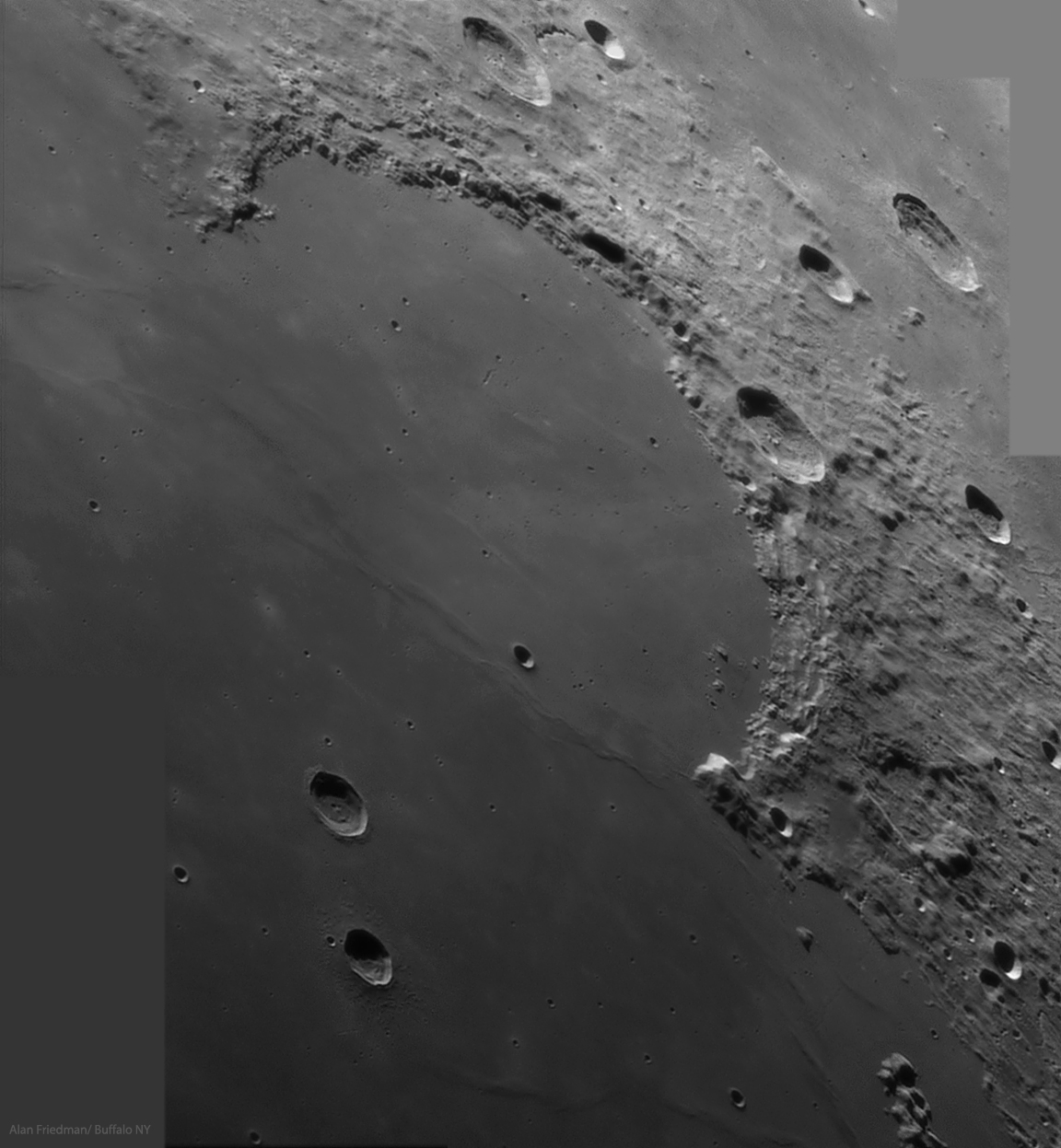
This is a picture of the moon's surface, of the features called the Bay of Rainbows and the Sea of Rains. These names, which historically come from the latin words for sea and ocean, are ironic seeing as these formations are created by lunar lava and the landscape of the moon is largely arid and dry. The moon maiden, or Cape Herclides is also shown in this picture. That's essentially it. Just the irony of the naming. Ayup.
Wednesday, February 6, 2008
APOD 3.5
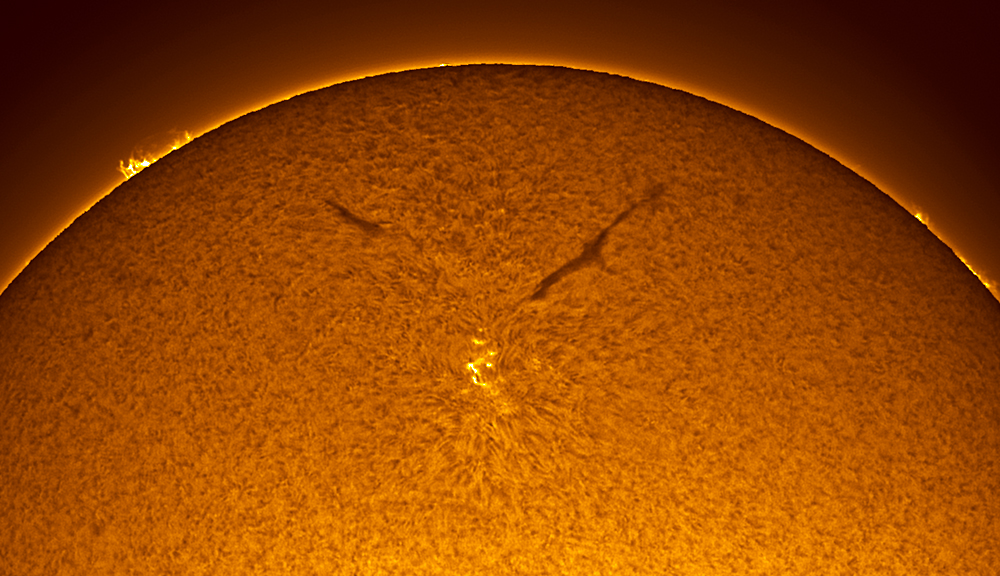
I found this APOD interesting because we were just talking about this in the last chapter. A new 11 year cycle is beginning on the sun, so this is one of the first sunspots of this cycle apparently. The two dark lines are cooler filaments held up by the sun's magnetic field. We're just not getting out of solar minimum (in 2007), with the last solar maximum being in 2001. This picture of the sun is the same as we've been looking about - darker regions are cooler regions. This picture was taken based on hydrogen. I would say more, but this is all just basically EXACTLY what we studied last chapter. Cool beans. And! I guess there's an annular solar eclipse tomorrow! Which Percy didn't tell us about. All though, since it's basically 'only for penguins' I guess it doesn't really matter much for us :( Well, at least the penguins get to enjoy it. I wonder if they act differently when the sun is freaking out...
Subscribe to:
Posts (Atom)