Day: December 7th
Place: SCC
Time: 7-9
Temperature: 60 ish degrees
We spent the earlier part of the night identifying constellations. The Summer Triangle was still vaguely in the sky to the West, but it fell as the night went on. We identified Polaris in order to get our bearings. We found Pisces by the circlet and momentarily confused Beetlejuice with Mars until Percy pointed out our mistake, which is what got us into the conversation of Orion's first magnitude stars. When Hannah came we re-identified the constellations we were familiar with, this time without help from Percy. One of the first things we looked at was the comet in Perseus. It was basically a big fuzz spot. I don't know that it could even be called white per say, it was just... fuzz. Once we had identified it in the binoculars, it was easy to see it without. We also looked at Subaru and the... hypeides? Spelling? The sister clusters. Due to Matt's request we looked at Uranus in the telescope, which was basically a blue dot and not overly exciting. Once Mars had risen over the treeline, we looked at it in the telescope and saw dark spots of continent sized formations on the planet. We also looked at M31 in Andromeda. The moon wasn't up.
Friday, December 14, 2007

2.7 Mars Rover runs to Hibernate
 With the northern winter phase of Mars fast approaching, scientists are trying to get the Mars Rover Spirit to a place called "home plate" in order to wait out the winter. Unfortunately for the Mars Rover, the soft sand of Mars keeps slowing the journey and scientists are uncertain as to whether Rover will make it in time. Once there, the Rover will tilt towards the sun in the hopes of increasing the efficiency of its energy absorbing solar panels. The picture shows a map of the Rover's journeys since landing in July of 2004.
Friday, December 7, 2007
2.6 APOD SOHO Solar Cycle

This is a picture of the sun's solar cycle (which takes 11 years) taken by the SOHO satellite currently orbiting the sun. A solar cycle is created by the sun's magnetic field. When the cycle is at the solar maximum, sunspots, coronal mass ejections, and flare phenomenons are at their highest whereas when the cycle is at the solar minimum, these occurances are less frequent. We are currently at a solar minimum (the last one was in 1996) and the solar maximum was in 2001. It's neat how you can actually see all the activity in the picture of 2001 whereas the pictures of 1996 and 2007 actually look dormant.
Friday, November 30, 2007
2.5 APOD Iridescent Cloud Over Colorado
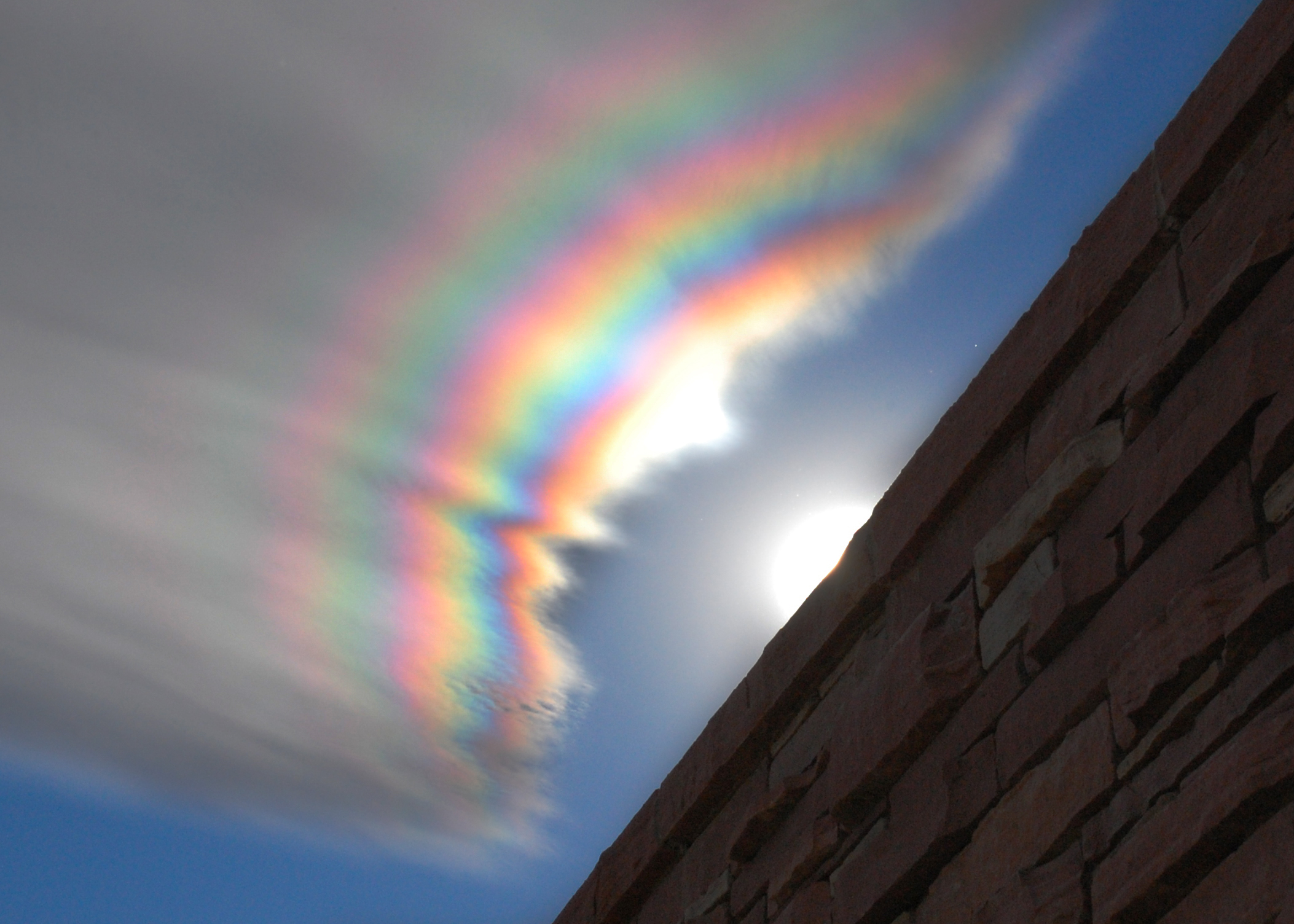
Looking like a three tiered rainbow, an iridescent cloud sits over Boulder, Colorado. This is a pretty rare event, but an iridescent cloud can show a whole spectrum of colors simultaneously. These clouds show colors when the clouds are relatively thin and the droplet sizes are about the same size. The light diffracts throw them, much like a rainbow. However, this only works if the sun is in exactly the right spot and mostly hidden by thick clouds. Sometimes iridescent clouds will start to form but then the cloud gets too thick or too far away from the sun. You can see why this would only occur rarely. One of the links (clouds) brings you to a page with a poem about clouds by William Wordsworth. Yay clouds.
Friday, November 16, 2007
2.4 APOD
For picture go to : http://apod.nasa.gov/apod/image/0711/cr_auger_big.jpg
For centuries astronomers have wondered where cosmic rays (energetic particles that begin in space and impinge on Earth's atmosphere and now the Pierre Auger Observatory in Argentina may have an answer. Auger suggests that 12 out of 15 ultra highhigh energy cosmic rays come from the direction of nearby active galactic nuclei (a compact region at the center of an active galaxy). These galactic centers emit large amounts of light and are probably feuled by a blackhole. The Auger Observatory believes that the highest energy rays are protons because any higher energy raywould be deflected by the Milky Way Galaxy's magnetic field and we wouldn't be able to figure out which direction the ray was coming from. The APOD picutre is of a ray striking Earth's atmosphere, with an active galaxy (Centaurus A) in the background as the galaxy from which the ray might have come.
For centuries astronomers have wondered where cosmic rays (energetic particles that begin in space and impinge on Earth's atmosphere and now the Pierre Auger Observatory in Argentina may have an answer. Auger suggests that 12 out of 15 ultra highhigh energy cosmic rays come from the direction of nearby active galactic nuclei (a compact region at the center of an active galaxy). These galactic centers emit large amounts of light and are probably feuled by a blackhole. The Auger Observatory believes that the highest energy rays are protons because any higher energy raywould be deflected by the Milky Way Galaxy's magnetic field and we wouldn't be able to figure out which direction the ray was coming from. The APOD picutre is of a ray striking Earth's atmosphere, with an active galaxy (Centaurus A) in the background as the galaxy from which the ray might have come.
Friday, November 9, 2007
2.3 APOD
This is a movie of an X-Class Flare Region (X-Class fares are the biggest ones) on the sun, and of a flare erupting there over a period of four hours. These violent flares can affect satellites and astronauts. This particular flare reached over ten million degrees Celsius and was probably caused by violently unstable magnetic reconnection events above the Sun (magnetic field lines interact and splice into one another, according to Wikipedia). The movie was capture by the TRACE (Transistion Region and Coronal Explorer) satellite, which is orbiting the Sun the study the connection between magnetic lines and plasma events on the Sun.
2.2 APOD Three Nebulae in a Narrow Band
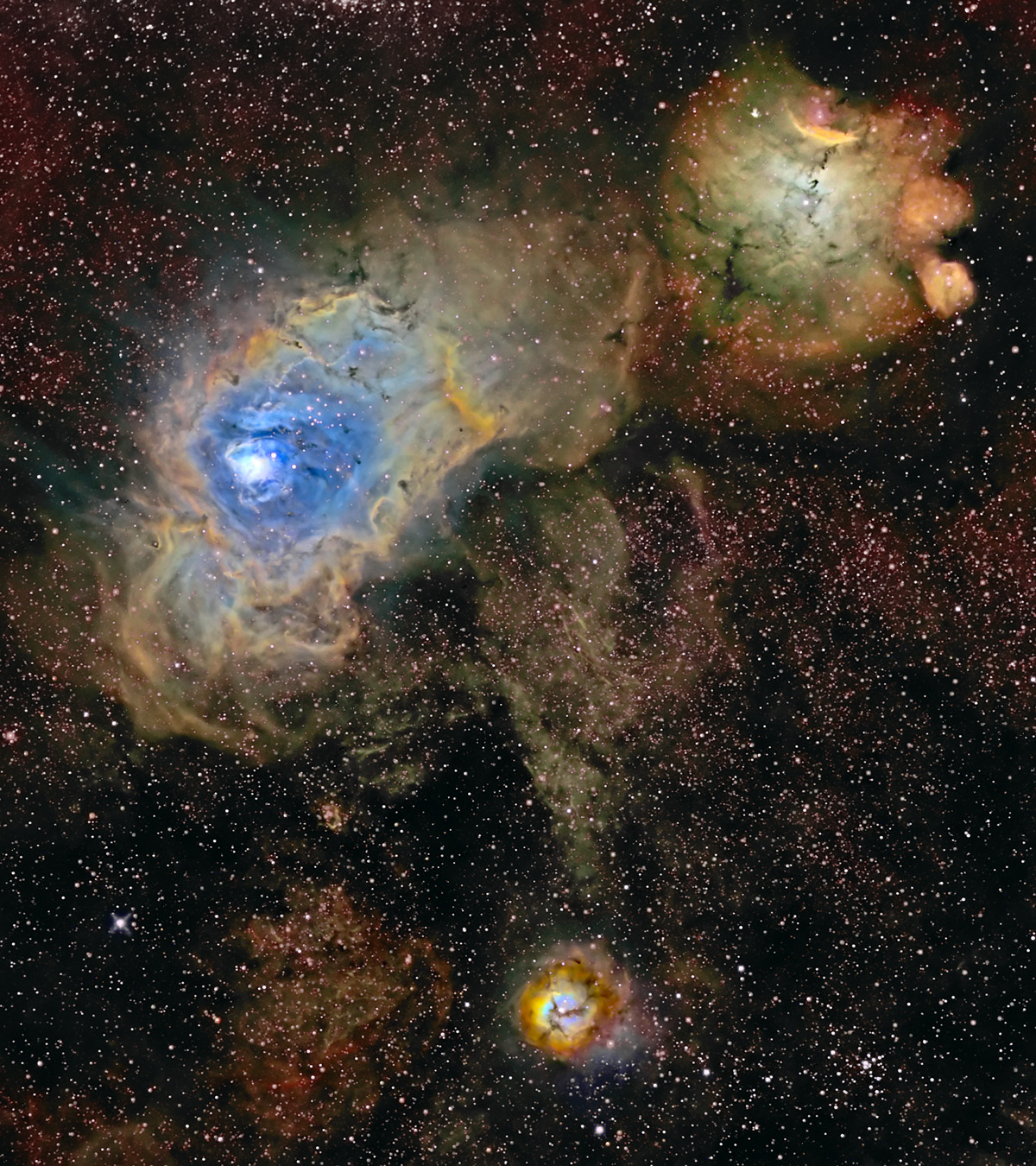 These are three Nebula found in Sagittarius, two of them the Nebula we have to remember for the constellation quiz - M8 (the Lagoon Nebula) and M20 (the Trifid). The Nebula in the upper right hand corner is NGC 6559 (who didn't make Messier's list. Poor baby.). This is a false color photo, with a color scheme apparently made common by the HUbble Telescope. The color scheme works for land based telescopes because it allows the astronomer to ignore urban light pollution. M8 is 30 light years LONG and about 5000 light years away. It's actually very pretty with the false color palete, a pretty blue, and is a star forming region.
Subscribe to:
Posts (Atom)